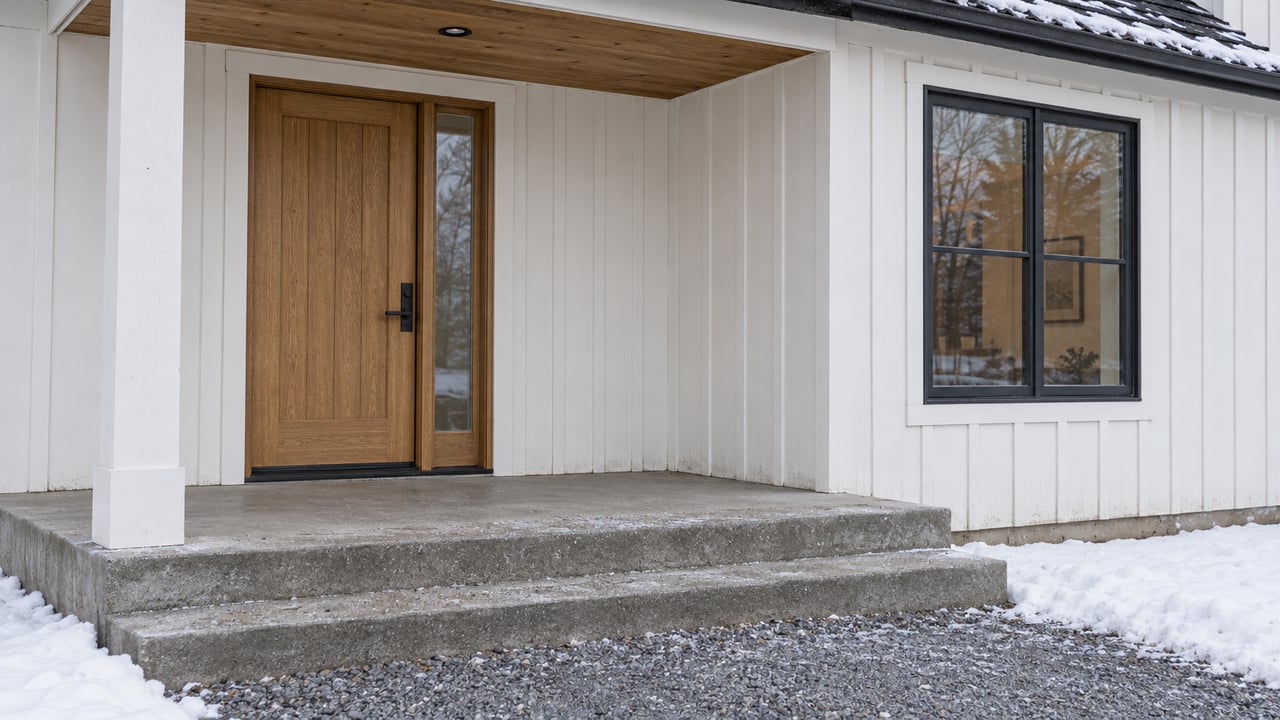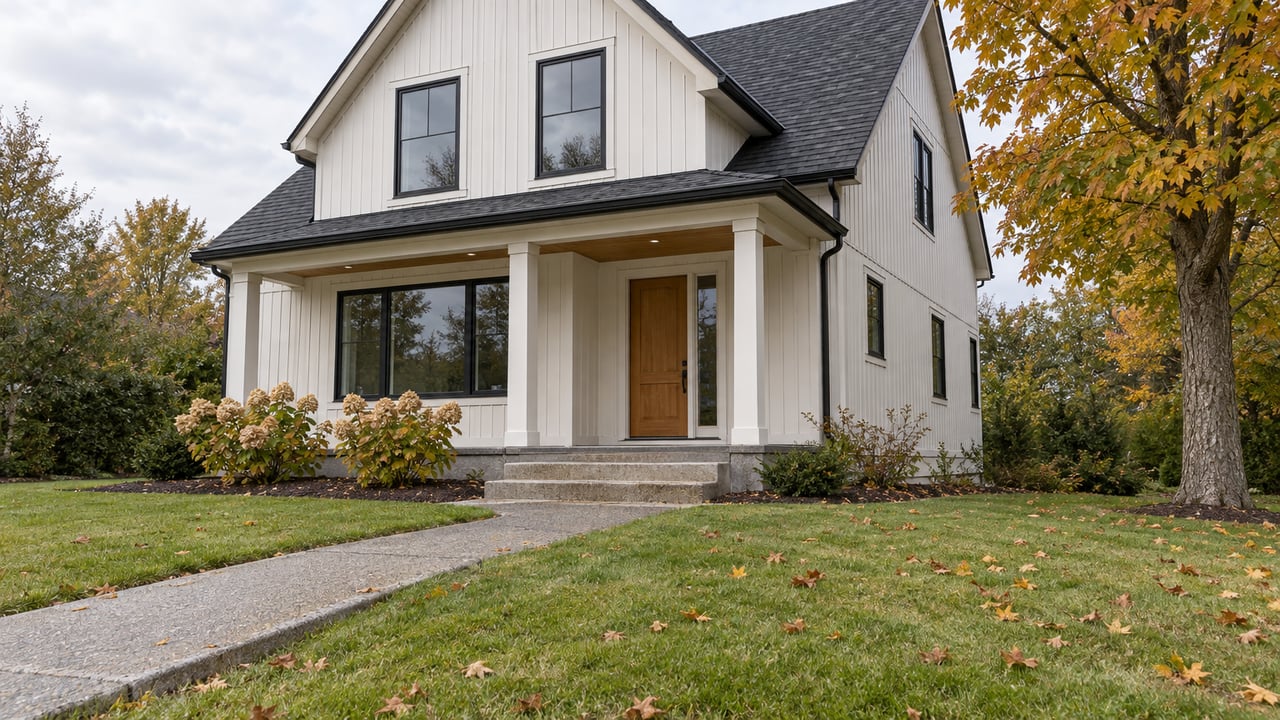
The Fredericton region is doing that thing markets do when the frenzy ends and nobody quite believes it yet. Regional average price sat at $366,962 in March 2026, essentially flat year over year, with active listings up 4.6% and unit sales down 10.7%. Buyers finally have room to think. If you have been comparing Hanwell against in-city Fredericton on a portal, you have probably noticed the Hanwell homes look newer, sit on bigger lots, and often ask a little less per square foot than a comparable build closer to downtown.
That gap is real. It is also not a discount. It is a redistribution of cost that only shows up once you understand one line buried in Hanwell's own governing document.
"A critical issue is managing the development of Hanwell without municipal water and sewer. Density is consequently controlled in consideration of the capacity limits of onsite treatment systems and wells." — Hanwell Rural Plan By-Law 37-2026, draft April 2026
That single sentence is why Hanwell behaves differently than any other suburb in the Capital Region, and why a Hanwell offer is not the same document as a Fredericton Southside offer.
Why lot supply in Hanwell doesn't loosen when the region loosens
Across Greater Fredericton, inventory has been climbing off historic lows. Year-end 2025 sat at roughly 2.9 months of supply against a balanced benchmark of four to six. The 2026 RE/MAX outlook expects prices to nudge up about 2% while sales cool around 7%. That is the shape of a market moving from seller to balanced, and eventually toward buyers.
Hanwell does not fully participate in that loosening on the supply side. With one tiny exception, the community is unserviced. Only the small Sloat and Lloyd Streets subdivision runs on a locally owned wastewater system. Everything else is private well and on-site septic, and the Rural Plan explicitly ties allowable density to what those systems can handle. New lots require soil percolation that supports a subsurface disposal field, plus setback distances from wells, property lines, and any nearby body of water. That is not a cyclical constraint that eases when interest rates fall. It is a physical one, tied to soil and geometry, and it caps how many new addresses the community can absorb no matter what the demand curve does.
The practical effect for a buyer: even in a softening region, a well-built home in Cobblestone Estates, Eagle Ridge, or Eaglewood does not linger the way a similar in-city home might. The scarcity is structural.
What the asking price is actually quoting you
When a listing in Fredericton proper says "$450,000," the city is handling the water main, the sanitary sewer, storm drainage, and the piece of infrastructure connecting your foundation to the street. You pay for that indirectly through property tax and utility billing. When a Hanwell listing says "$450,000," you are buying the entire water and sewage stack on the property itself, plus the land it sits on.
That is not a worse deal. It is a different deal. Here is how the cost categories rearrange:
| Cost category | In-city Fredericton | Hanwell |
|---|---|---|
| Water supply | Municipal, billed monthly | Private drilled well on the lot |
| Wastewater | Municipal sanitary sewer | Septic tank plus subsurface disposal field |
| Ongoing "utility" cost | Water and sewer fees | Pump service, septic pump-out every three to five years, filter replacements |
| Capital risk | City replaces mains | Owner replaces pump, pressure tank, tank, or leach field |
| Regulatory touchpoint | City of Fredericton | GNB Justice and Public Safety, plus Capital Region Service Commission for permits |
The "extra house for the money" reads less like a bargain once you allocate a private capital reserve for the systems the city would otherwise be maintaining for you. It also reads more like a fair trade if you would rather own the systems outright than pay a monthly bill for them. Move-up families who understand this going in tend to be happy in Hanwell for a long time. The ones who miss it are the ones who feel blindsided at year four when the pressure tank goes.
The inspection stack that keeps a Hanwell deal from unraveling in week three
A standard home inspection is not enough here. It is the starting point. On a serviced Fredericton home, an inspector opens the panel, tests the fixtures, checks the roof, and you are largely done. On a Hanwell home, the inspection contingency needs to be broader, and the buyer's schedule has to accommodate more moving parts. This matters especially for military and RCMP families running a compressed House Hunting Trip on a BGRS timeline. If the contingency window is only a week, you cannot fit everything in.
A Hanwell-ready inspection contingency should include:
- The standard home inspection.
- A well water potability and quality test, including bacteria and nitrates at minimum. Additional testing for arsenic, uranium, or manganese is worth discussing based on the specific well record.
- A well condition and flow test, ideally with the well record pulled so you know depth, casing, and static level.
- A septic tank and leaching field inspection by a licensed installer. Systems typically last 20 to 25 years, and replacement can easily reach five figures, which is why this line item is not optional.
- A sewer scope on the line between house and tank if the property is older or has mature trees on the run.
The provincial regulator for on-site sewage is the Department of Justice and Public Safety, and any new or replacement system requires a licensed installer to submit an application, an inspector to assess it against the New Brunswick Technical Guidelines, and a final inspection before the system is covered. If a deal turns up a failing field, that is the process you are stepping into, and it does not happen in a week.
Sellers in Hanwell get the same benefit if they run this stack pre-listing. A clean well test and a recent septic pump-out sitting on the counter at showings is worth more than a staging consultation. It removes exactly the questions that make buyers hesitate.
Reading a Hanwell listing by where it sits
The community splits along Route 640, and the split matters when you are reading a listing.
Northwest of the road, around Camber Drive and Deerwood Drive, you get a mix of modest and executive homes built from the 1970s through the mid-2000s, with newer infill in recent years. On these properties, the well and septic are usually not new. Ages vary lot to lot, and the inspection contingency is doing most of its work here. Ask for the septic install date and any pump-out records the seller can find.
Southwest of the road is where Starlite Construction has been building for decades. The original Starlite subdivision is the one with streets named after planets and celestial bodies. Newer Starlite work is concentrated in Cobblestone Estates, Eaglewood, and Eagle Ridge. Homes here trend newer and larger, which usually means newer systems too, but "new" is not "no inspection." A five-year-old system installed on marginal soil can behave worse than a twenty-year-old system on ideal soil. The install approval and soil evaluation are the documents that tell you which situation you are in.
At the western edge, around Yoho Lake, and inside the annexed communities of French Village, Island View, and Mazerolle Settlement that joined Hanwell on January 1, 2023, lots trend larger, more rural, and more variable. Setbacks from the lake influence what can be installed where. If a waterfront lot is on your list, the septic conversation moves to the front of the offer, not the back.
A short FAQ
Does a well and septic make financing harder? Not usually, but lenders and insurers do want to see a passing water test and a functioning septic system. Building the well and septic reports into the inspection period, rather than leaving them for after conditional removal, keeps the closing on track.
What does the province charge to permit a new or replacement septic system? The application fee to Service New Brunswick is $150 as of the current instruction sheet, plus the licensed installer's own costs. The system has to be inspected and approved before it is covered.
Is the "unserviced" language likely to change? The Rural Plan draft published in April 2026 treats managing growth without municipal water and sewer as an ongoing planning constraint, not a short-term problem. Plan around the current reality, not a hypothetical extension.
How does this affect a simultaneous sale and purchase? The Hanwell side of a coordinated move needs a longer inspection window than the Fredericton side. If you are selling in the city and buying in Hanwell in the same week, that asymmetry is the single most common reason schedules slip.
If Hanwell is on your list, the goal is not to talk yourself into or out of the well and septic. It is to price them into the offer accurately and to build a contingency period that respects how the systems actually work. That is where a construction-aware conversation before you write an offer pays for itself many times over. When you are ready to walk through a specific property or map out an HHT week that fits a Hanwell purchase into a military or RCMP posting, Megan Gallant is happy to sit down and talk it through. Let's Talk.