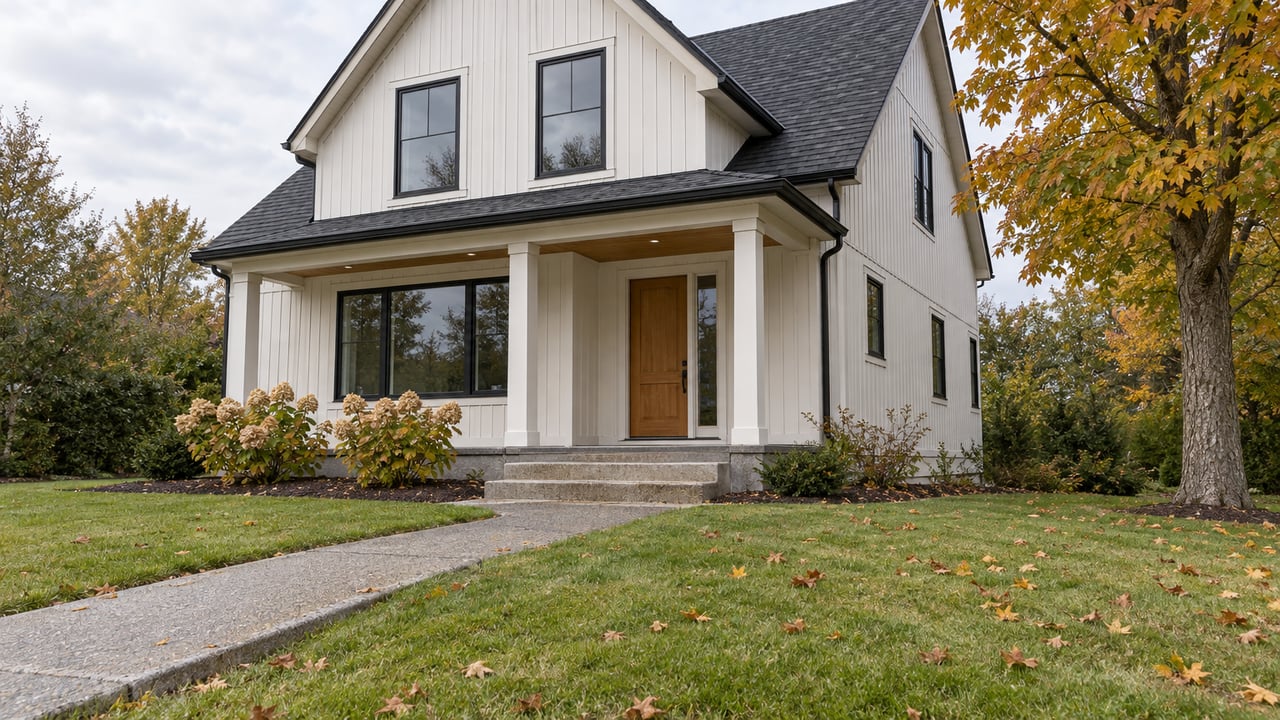
Two Hanwell homes can share a floor plan, a builder and a street, get started a few weeks apart this winter, and still be built to different energy standards. The day you sign the contract doesn't decide which standard yours meets. The day a substantially complete permit application lands with the building department does. And the warranty on the house comes down to whatever your builder decided to offer, because New Brunswick doesn't require one.
If you're close to signing on a new build in Hanwell, those two documents matter more than the rendering, the model name or the finishes sheet. This post covers why, and what to ask for.
The Date That Decides Your Code
On October 2, 2026, the province's Building Code Administrator, Trevor Murray, issued Technical Bulletin No. 2026-02. It says New Brunswick has adopted the 2025 editions of the National Model Construction Codes, effective January 1, 2027. Right now, the province's building code page lists the National Building Code of Canada 2020, adopted at energy efficiency Tier 2. Under the new adoption, the National Building Code moves to Tier 3 and adds an operational carbon level of "C."
This line in the bulletin is the one that matters for a buyer:
"The correct edition of code to be used for design or construction is the code edition in effect the date that a substantially completed application has been submitted to the building department."
The bulletin goes on to say an application form alone may not be enough, and that the building inspector decides whether an application is substantially complete.
The bulletin builds in two transition allowances:
- A project that already has a phase permitted under the current codes may keep using that edition for the phases that immediately follow, at the building inspector's discretion. This doesn't apply where a local building by-law sets its own rules for phased permits.
- Roof trusses built to the 2020 National Building Code will still be accepted for applications submitted no later than April 1, 2027, because trusses are often ordered well before a permit application goes in.
This post goes live on October 22, so there are about ten weeks left before the switch. If your builder is pulling the permit in December, your house is probably designed to the 2020 edition at Tier 2. If a substantially complete application doesn't go in until January, it falls under the 2025 edition at Tier 3. Whether an application filed in December actually counts as substantially complete is up to the inspector. Both can be fine homes. They aren't the same spec, though, and your purchase agreement may never mention which one you're getting.
Why the Calendar Matters More in Hanwell
Hanwell is where many new single-detached homes in the Fredericton area are going up. The Hanwell Rural Community Plan By-Law 37-2026 describes recent development as single-detached homes on estate lots of one acre or more, sized to fit provincially approved septic systems. The same plan says the province estimated Hanwell's population at 7,100 in 2023 and calls the community "poised to grow."
A custom or semi-custom build on an acre lot doesn't move like a spec townhouse. You might need lot approvals, a septic design and plan revisions before the application counts as complete, and any one of them can push the submission date. We've covered the well, septic and lot side of Hanwell pricing in what Hanwell's asking prices don't tell you. This winter, the same paperwork also decides which code your walls are built to.
What the Permit Inspection Covers
It's easy to assume a house that passed its inspections has been checked for quality. Hanwell's building by-law describes something narrower than that.
Hanwell's Building By-Law 09-2015 says permits are issued by the Building Inspector, and it names Regional Service Commission 11 as the Commission. It requires the builder to give notice for inspection at these points:
- Foundation walls, before backfill
- Insulated concrete form or structural slab pours
- Insulation and vapour barrier, before drywall
- Completion
- "Such other inspections as may be required"
The by-law also says that issuing a permit, reviewing plans or doing inspections "shall not relieve the permit holder from full responsibility" for meeting the by-law. At the provincial level, the Building Code Administration Act lets inspectors inspect for compliance with the building by-law, the Act and its regulations.
A permit inspection checks compliance at set stages. It doesn't come with a promise to fix anything after you move in. That's the job of a warranty, and nobody requires one.
The Warranty Is the Builder's Choice
In July 2026, CBC News reported on homeowners caught in contractor disputes elsewhere in the province. The story quoted Claudia Simmonds, CEO of the Canadian Home Builders' Association of New Brunswick. She said British Columbia, Alberta, Ontario and Quebec require contractor licensing, warranty and training, and that those rules don't exist in Saskatchewan, Manitoba or anywhere on the east coast. In the same CBC report she said, "Anyone can pick up a hammer tomorrow and decide they're going to be a renovator or a builder, new home builder, and if they can find someone to hire them, then they're in business." CBC also reported that she's calling for mandatory contractor registration, which would bring a complaints and discipline process.
Many builders do offer warranties, but the coverage depends on which program the builder signed up with. Here's how the two programs active in the region describe their published structures:
| Coverage | Atlantic Home Warranty base coverage | Lux Residential Warranty published structure |
|---|---|---|
| Builder workmanship | 1 year | 1 year |
| Electrical and plumbing distribution | 2 years | Not listed separately |
| Building envelope or water penetration | 3 years, major structural defect from water penetration | 5 years, envelope |
| Major structural | 10 years | 8 years |
| Stated limit | $70,000 per home, including engineering fees | Not stated on the coverage page |
The sources are the Atlantic Home Warranty coverage page and Lux's protection page. Lux also advertises a separate dry-basement option.
Even inside one program, what a builder describes can differ from the generic page. One Hanwell builder working on Caleah Lane says every home it builds carries an 8-year Lux warranty, and it summarizes that as first-year repair and workmanship plus eight years on major structural defects affecting load-bearing parts. That summary is shorter than Lux's own published list. The certificate for your address is the document that sets your coverage. The program's website and the builder's brochure don't.
CHBA-NB's buyer guidance says its members join voluntarily and are required by their membership criteria to provide warranties on new homes. That guidance is from 2020, but the July 2026 CBC report describes the same voluntary setup in Atlantic Canada.
What to Have in Hand Before You Sign
Since the code edition and the warranty are each set by a separate document, ask for both before you commit. Here's the list I'd want on the table:
- The permit application status. Has a substantially complete application been submitted, and has the inspector confirmed it qualifies? If not, what's the target submission date?
- The code edition in writing. Ask which edition and energy tier the plans are designed to, and whether the contract says what happens if the application lands after January 1, 2027.
- Phasing, if there is any. If part of the project is already permitted, ask whether the builder expects the inspector to allow the current edition for the next phases.
- Warranty enrollment. Get the program name, proof the home will be enrolled, and a sample certificate showing the actual terms and limits.
- Membership claims. If the builder says it belongs to CHBA-NB, ask how that affects its warranty obligations.
This is general information, not legal or financial advice. Have a lawyer review your purchase or construction contract, and confirm the code and permit details for your own lot with the building department.
Quick Questions
If my contract is signed in November, am I locked into the 2020 code? Not automatically. Bulletin 2026-02 ties the code edition to the date a substantially complete permit application is submitted, and the building inspector makes that call.
Does passing the final inspection mean the house has no defects? Hanwell's building by-law says permits, plan review and inspections don't relieve the permit holder of full responsibility for compliance. Defects that show up after you take possession are a warranty question.
Is a warranty required for a new home in New Brunswick? According to CHBA-NB's CEO, as reported by CBC News in July 2026, warranty and licensing rules don't exist on the east coast. Whether your home has one, and what it covers, comes down to your builder and your certificate.
If you're comparing builders in Hanwell before January 1, I can go through the permit timing, the code edition and the warranty certificate with you before you sign. I co-own a residential contracting company, so I read build documents line by line. See how I work with new construction buyers, or reach out to Megan Gallant and let's talk.